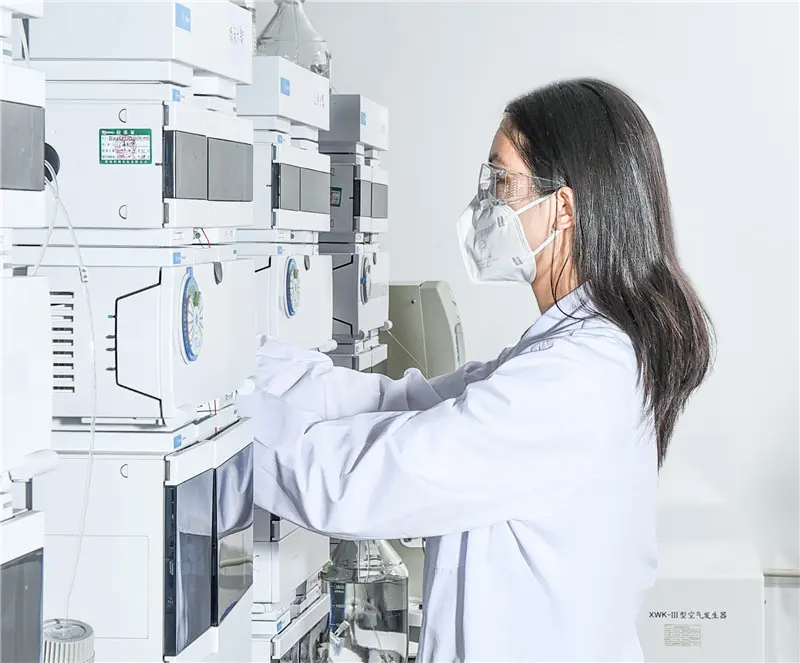
Phytochemical Quality Matrix & ISO/IEC 17025 Compliance

OEM Finger Print Chromatography Supplier & Suppliers

Enterprise Chromatographic Profiling, Holistic Multi-Compound Fingerprint Characterization, and Global Regulatory Batch-to-Batch Standardization for High-Complexity Botanicals

Qualified Analytical Portfolio

Integrated R&D & CDMO Botanical Solutions

Direct contract access to our state-of-the-art pilot facilities, modern extraction centers, and certified testing models.


OEM Animal Study Supplier

OEM Animal study Supplier, Suppliers

Explore Service
Establishment of Analysis Methods

China Establishment of analysis methods of active ingredient(s) Supplier, Suppliers

Explore Service
Potency Study Across Origins

ODM Study and evaluation of the potency of the botanical active ingredient(s) from different seasons and different origins. Manufacturer, Suppliers

Explore Service
Screening of Active Ingredients

China Screening of the active ingredient(s) of plants Manufacturer, Manufacturers

Explore Service
Clinic Study Phase 1-4

ODM Clinic study (Phase1 - Phase 4) Manufacturer, Suppliers

Explore Service
In Vitro Test Service

OEM In Vitro Test /Research Service Manufacturers, Suppliers

Explore Service
Fingerprint Chromatography Standard

OEM Finger Print Chromatography Identification Method Development

Explore Service
Botanical Active CDMO

Commercial CDMO Batch-to-Batch Fingerprint Validated Production

Explore Service
Global Industrial Landscape

The Paradigm Shift in Botanical Chemical Profiling

Transitioning from single-marker quantification to systemic chromatographic pattern recognition (Fingerprint Chromatography) under strict FDA, EMA, and NMPA regulatory ecosystems.

Beyond Single-Compound Assays

Traditional herbal assay methods have relied heavily on measuring one single marker (e.g., ginsenosides, curcuminoids), leaving formulations vulnerable to economic adulteration, intentional spiking, and unseen batch variance. Modern OEM Finger Print Chromatography supplies an immutable, comprehensive chemical "barcode" of the entire botanical matrix.

Global Pharmacopoeial Alignment

Regulatory authorities worldwide—including the US-FDA Botanical Drug Development Guidance, European Pharmacopoeia (Ph. Eur.) 11th Edition, and the Chinese Pharmacopoeia (ChP 2020/2025)—mandate multi-wavelength HPLC, UHPLC-Q-TOF-MS, and HPTLC fingerprint similarity scores (>0.90 to 0.95) for release approval.

Chemometric Data Integration

Current industrial leaders leverage unsupervised Principal Component Analysis (PCA), Hierarchical Cluster Analysis (HCA), and Orthogonal Partial Least Squares-Discriminant Analysis (OPLS-DA) to link specific chromatographic peak areas directly to biological activity and pharmacological potencies.

Technical Whitepaper Architecture

Analytical Methodologies & Method Development Stack

Our ISO-certified multi-dimensional chromatographic infrastructure engineered to validate complexity, authenticity, and yield stability.

Analytical Modality Core Instrumentation Detection Limit / Precision Industrial Application Spectrum
HPTLC Digital Fingerprinting CAMAG Automatic TLC Sampler & Visualizer 2 Visual confirmation / Rf variance < 0.02 High-throughput botanical raw material discrimination, adulteration checks, and rapid identity verification.
Reversed-Phase HPLC-DAD/ELSD Agilent 1290 Infinity II / Waters Alliance e2695 RSD < 0.8% across common peak profiles Routine batch release testing, active marker quantification, similarity computation against reference chromatograms.
UPLC-ESI-Q-TOF-MS/MS Waters ACQUITY UPLC / Synapt G2-Si HDMS Sub-ppm mass accuracy / structural elucidation De-novo discovery of minor metabolites, pesticide and toxin traces, degradation pathways, and cross-species verification.
Headspace GC-MS/FID Shimadzu GCMS-QP2020 NX System Parts-per-billion (ppb) resolution Aroma and volatile terpene mapping, residual solvent profiling (USP <467>), and essential oil fingerprinting.
Chemometric Similarity Engine Matlab / ChP Chromatographic Fingerprint Evaluation Software Vector cosine correlation > 0.950 Automated similarity evaluation, cluster grouping of seasonal shifts, and cross-regional provenance identification.
Enterprise Scale & Validation

Empirical Benchmark Behind Our Analytical CRO/CDMO

Backed by 14+ years of proprietary phytochemical datasets, academic-grade research, and commercial compliance.

14+
Years Specialized CRO/CDMO Experience
400+
Single-Herb Fingerprint Standards Built
300+
Full-Time Analytical & Clinical Scientists
83
Classic Formula Fingerprint Dossiers Modernized
Targeted Market Deployment

Localized Application Scenarios for Global Tier-1 Brands

Translating analytical fingerprint datasets into concrete risk reduction and market access across international borders.

North American cGMP (21 CFR Part 111) Verification

Dietary supplement brands face rigorous FDA identity testing rules requiring scientifically valid methods. Our HPTLC and HPLC fingerprint datasets provide ironclad substantiation of botanical identity, confirming species legitimacy down to the chemotype level without false-positive cross-reactions.

European Herbal Medicinal Products (HMPC / THMPD)

Regulatory registration of Traditional Herbal Medicinal Products demands comprehensive qualitative profiles demonstrating batch-to-batch consistency across multiple agricultural seasons. We supply complete chromatographic validation portfolios matching Ph. Eur. monographs.

High-Efficacy Clean-Label Functional Cosmetics

Cosmeceutical manufacturers demand clear scientific differentiation. By applying high-resolution chromatographic profiling, we isolate active polyphenol, flavone, or triterpene signatures, ensuring every commercial extract delivers provable skin-barrier enhancement and cellular protection.

Technological Roadmap

Next-Generation Fingerprint Chromatography: The 2025–2030 Horizon

Strategic integration of artificial intelligence, orthogonal mass-detection, and automated continuous-process monitoring.

Phase I: Current

Multi-Wavelength HPLC / DAD Baseline

  • Correlation coefficient similarity threshold > 0.950
  • Multi-marker simultaneous quantification
  • Digital HPTLC spectral track comparison
  • Raw herb origin geographic correlation
Phase II: In Development

2D-LC Orthogonal Peak Deconvolution

  • Heart-cutting and comprehensive 2D-LC (LCxLC)
  • Separation of overlapping isomers and trace saponins
  • Direct hyphenation to high-resolution accurate mass MS
  • Elimination of analytical blind spots
Phase III: Strategic Rollout

AI-Driven Chemometric Spectrum Recognition

  • Deep-learning neural networks for automated spectral matching
  • Real-time automated adulterant identification
  • Dynamic origin fingerprint prediction based on climate data
  • Predictive shelf-life degradation mapping
Phase IV: Industrial Scale

In-Line Process Analytical Technology (PAT)

  • Continuous NIR and flow-cell chromatographic monitoring
  • Closed-loop feedback for commercial extraction columns
  • Instantaneous batch-to-batch similarity validation
  • Real-time release (RTR) manufacturing pipelines
Holistic OEM/CDMO Architecture

End-to-End Solutions: From Raw Agronomy to Regulated Delivery

How MedGence bridges the structural gap between pure chromatographic science and commercial manufacturing.

1. Agronomic Geocoding & Screening

We screen active botanical materials across multiple geographical coordinates, altitudinal variations, and seasonal harvests, identifying the unique phytochemical profiles that yield maximum biological potencies before committing to mass supply agreements.

2. Method Standardization & Tech Transfer

Our ISO-standard labs establish ICH Q2(R1)-validated HPLC, UPLC, and HPTLC testing standards. These validated analytical standard operating procedures (SOPs) are transferred to your in-house QC laboratory or maintained at our pilot plants for ongoing lot release.

3. Industrial OEM/CDMO Formulation

Study results transfer directly into commercial extraction, column separation, spray drying, and dosage blending. We deliver finished liquids, extract powders, softgels, tablets, and granules accompanied by batch-specific fingerprint similarity reports.

Technical & Procurement Inquiries

Frequently Asked Questions: Chromatographic Quality Systems

Definitive answers on analytical validity, similarity calculations, regulatory compliance, and OEM delivery.

What is Fingerprint Chromatography and why is it superior to single marker assays?
Fingerprint chromatography is an integrated analytical technique that maps the complex multi-compound chemical distribution of a botanical extract into a distinct spectral curve. Unlike traditional single-marker assays that quantify only one component (and can be deceived by spiking adulterants), fingerprint chromatography visualizes both primary and secondary metabolites, establishing total chemical integrity, origin confirmation, and biological potency stability.
How is chromatographic fingerprint similarity mathematically determined?
Similarity is calculated using cosine vector correlation or correlational coefficient algorithms comparing sample peak profiles against a validated Reference Standard Chromatogram (RSC). A similarity index score approaching 1.0 (typically >0.90 to 0.95 across 10 to 30 characteristic peaks) confirms chemical identity and strict batch-to-batch consistency as prescribed by international pharmacopoeias.
Can MedGence formulate and supply commercial finished products matching these fingerprints?
Yes. Beyond analytical method development (CRO services), MedGence operates pilot facilities and collaborative manufacturing plants (CDMO). We transfer chromatographic parameters directly into industrial extraction, purification, and finished dosage form manufacture (capsules, tablets, liquids, softgels, granules), delivering products that come backed by full analytical dossiers.
How does our chromatographic OEM service support FDA Botanical Drug Submissions?
The FDA Botanical Drug Guidance specifically mandates complete chromatographic profiling to establish Chemistry, Manufacturing, and Controls (CMC) consistency. We deliver ICH-compliant method validation reports, multi-batch reproducibility studies, forced-degradation stability studies, and chemical fingerprinted lot documentation essential for IND/NDA filings.
How do you safeguard client intellectual property, proprietary recipes, and formulations?
We adhere to strict non-disclosure legal contracts (NDA) under an entrusted CRO/CDMO governance model. All research findings, chromatographic protocols, proprietary purification schemes, and formulation parameters remain exclusively the client’s intellectual property and are isolated within firewalled, audit-ready data environments.
Comprehensive Sourcing Directory

Explore Full Scientific CRO & CDMO Solutions

Connect with our technical managers to scale your analytical development, pre-clinical trials, and contract production.

OEM Animal Study Supplier

OEM Animal study Supplier, Suppliers

Explore Service
Establishment of Analysis Methods

China Establishment of analysis methods of active ingredient(s) Supplier, Suppliers

Explore Service
Potency Study Across Origins

ODM Study and evaluation of the potency of the botanical active ingredient(s) from different seasons and different origins. Manufacturer, Suppliers

Explore Service
Screening of Active Ingredients

China Screening of the active ingredient(s) of plants Manufacturer, Manufacturers

Explore Service
Clinic Study Phase 1-4

ODM Clinic study (Phase1 - Phase 4) Manufacturer, Suppliers

Explore Service
In Vitro Test Service

OEM In Vitro Test /Research Service Manufacturers, Suppliers

Explore Service
Fingerprint Chromatography Standard

OEM Finger Print Chromatography Identification Method Development

Explore Service
Botanical Active CDMO

Commercial CDMO Batch-to-Batch Fingerprint Validated Production

Explore Service