Explore our core discovery, screening, and chromatographic assay development services engineered for biopharmaceutical, nutraceutical, and cosmetic formulation enterprises.
High Performance Liquid Chromatography (HPLC) has transitioned from an isolated quality-assurance checkpoint into the fundamental analytical bedrock of global botanical drug development, nutraceutical standardization, and biopharmaceutical synthesis. As the pharmaceutical industry confronts increasingly complex multi-component matrices—such as polyherbal extracts, secondary plant metabolites, therapeutic peptides, and biosimilars—the demand for high-resolution separation techniques has surged. Traditional isocratic HPLC configurations have progressively yielded to Ultra-High Performance Liquid Chromatography (UHPLC), multidimensional chromatography (2D-HPLC), and hyphenated techniques including HPLC-MS/MS and HPLC-PDA-ELSD.
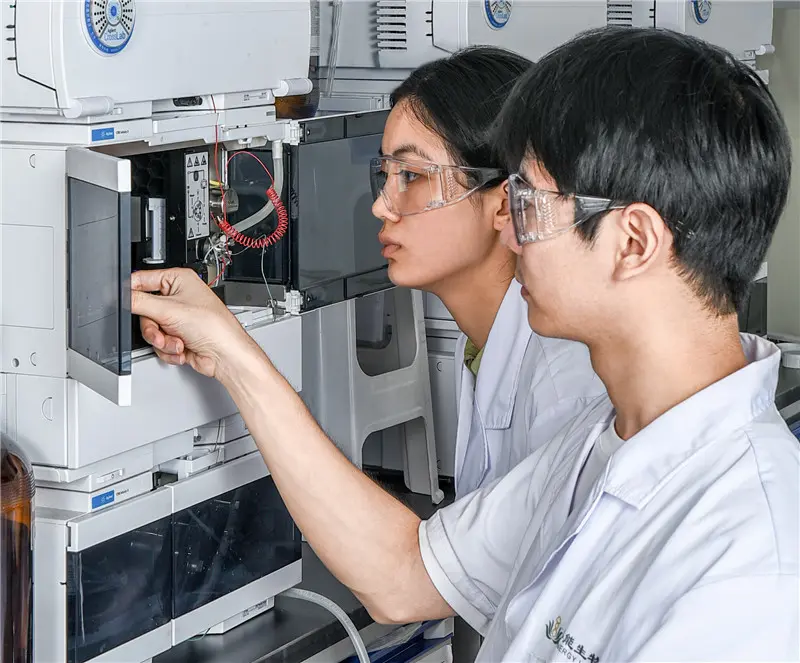
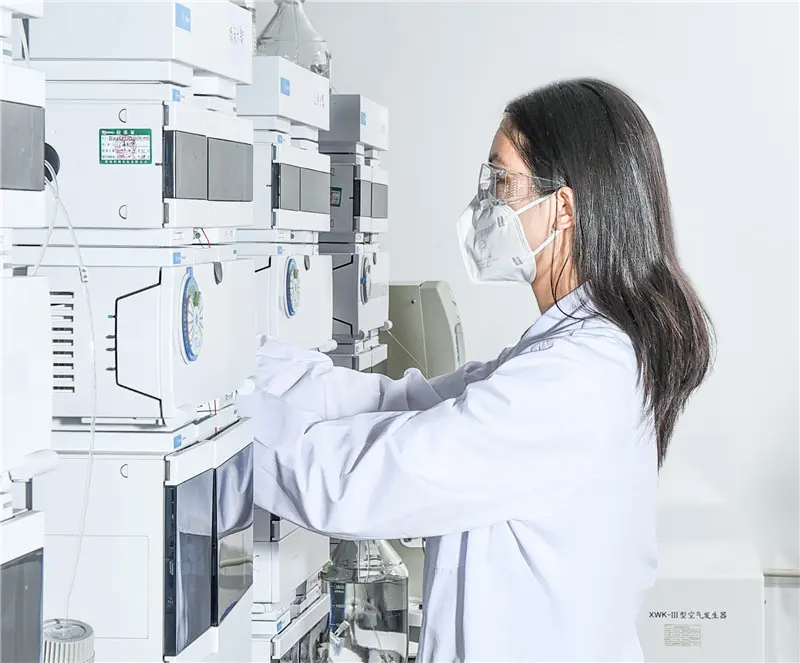
Within the botanical medicine and healthcare sectors, active phytochemicals seldom exist in isolation. Therapeutic efficacy typically results from synergistic networks comprising alkaloids, flavonoids, polyphenols, triterpenoid saponins, and polysaccharides. Identifying, profiling, and quantifying these trace compounds requires rigorous selectivity, minimal band broadening, ultra-stable retention parameters, and sub-nanogram sensitivity. As an established ODM High Performance Liquid Chromatography manufacturer and contract R&D supplier, MedGence (Yineng Pharma) operates high-precision liquid chromatography systems designed to address challenging peak co-elution, severe baseline drift, and complex matrix interferences.
Modern HPLC technology integrates sub-2-micron particle packed columns, core-shell column engineering, and biocompatible quaternary pumps capable of withstanding pressures upwards of 1,200 to 1,500 bar. This evolution enables rapid chromatographic screening cycles—reducing standard run times from 60 minutes down to less than 8 minutes without sacrificing peak capacity or chromatographic resolution. Consequently, pharmaceutical innovators can now accelerate early-phase drug target validation, batch-to-batch consistency tracking, and stability monitoring with unprecedented statistical confidence.
Evaluating analytical equipment suppliers, chromatographic method developers, and contract manufacturing partners requires a multi-dimensional technical matrix.
Global procurement teams prioritize chromatographic methods that execute seamlessly across multiple instrumental platforms (e.g., Agilent, Waters, Shimadzu, Thermo Fisher) without variation in retention indices or peak symmetry. Documented robustness testing across pH, temperature, and column lot variance is mandatory.
Every chromatographic run must maintain an unalterable audit trail. Procurement specialists mandate software environments featuring role-based access control, automated time-stamped system logs, and cryptographic verification to prevent data manipulation in accordance with US FDA 21 CFR Part 11 and EU Annex 11.
Modern biopharmaceutical procurement requires autosamplers equipped with multi-solvent dynamic wash routines that limit sample carryover to less than 0.002%. Columns must maintain high theoretical plate counts (N > 120,000 plates/m) under rigorous high-throughput continuous injection schedules.
| Evaluation Parameter | Legacy HPLC Systems | Enterprise ODM UHPLC Platform | MedGence CRO Analytical Standard |
|---|---|---|---|
| Operating Pressure Limit | Up to 400 bar (5,800 psi) | 1,000 – 1,500 bar (22,000 psi) | Dual Configuration (400 bar & 1,300 bar UHPLC) |
| Stationary Phase Particle Size | 3.0 μm – 5.0 μm porous silica | 1.5 μm – 1.9 μm sub-2-micron / Core-shell | Core-shell & Monolithic specialized phases |
| Injection Cycle Time | 45 – 90 minutes per sample | 5 – 15 minutes per sample | Automated multiplexed parallel gradients (< 10 min) |
| Regulatory Traceability | Manual logs / basic CDS integration | Centralized enterprise CDS (Part 11) | Fully integrated LIMS + 21 CFR Part 11 compliant audit |
| Matrix Applicability | Single-target synthetic compounds | Complex chemical cocktails | Crude botanical extracts & high-matrix polyherbal formulas |
MedGence's integrated methodology links high-resolution HPLC assay validation directly with clinical research and large-scale cGMP manufacturing.
Geographical provenance, solar exposure, altitude, and seasonal harvesting times create wild swings in secondary metabolite concentrations. By deploying targeted reversed-phase HPLC alongside chiral stationary phases, we map chemical fingerprints across raw harvests, identifying specific terroir lots that yield maximum pharmacological potency while minimizing toxic byproduct markers.
Across 14+ years of specialized research, MedGence has deciphered 83 classic Traditional Chinese Medicine (TCM) formulas. Using HPLC multi-wavelength monitoring and evaporative light scattering detectors (ELSD), our teams establish stoichiometric fingerprint standards that transition multi-herb decoctions into registered, reproducible medical preparations.
Analytical chromatography parameters established in the laboratory are mathematically scaled to preparative HPLC columns (ranging from 50 mm to 300 mm internal diameter). This enables seamless translation from microgram-level screening batches directly into metric-ton industrial extraction runs with zero loss in yield or enantiomeric purity.
Overcoming jurisdictional hurdles requires strict adherence to international pharmacopoeial guidance and comprehensive validation packages.
Operating as a premier contract development and analytical manufacturing partner requires exhaustive regulatory alignment across international jurisdictions. Whether submitting an Investigational New Drug (IND) dossier to the US FDA, registering a Botanical Drug Substance under EMA guidance, or filing a modern hospital preparation in China under NMPA statutes, analytical validation must adhere to ICH Harmonised Tripartite Guideline Q2(R1) — "Validation of Analytical Procedures: Text and Methodology."
Our HPLC method validation protocols quantify Specificity, Linearity (r² > 0.999), Accuracy (recovery rates between 98.0% – 102.0%), Precision (Repeatability < 1.5% RSD, Intermediate Precision < 2.0% RSD), Detection Limits (LOD at S/N > 3:1), and Quantitation Limits (LOQ at S/N > 10:1) across forced degradation stress tests (acid, base, peroxide, thermal, and photolytic exposure).
Analytical methods are validated simultaneously across United States Pharmacopeia (USP <621> Chromatography), European Pharmacopoeia (Ph. Eur. 2.2.46), and Chinese Pharmacopoeia (ChP General Chapter 0512). This allows multinational pharmaceutical brands to export finished dosage forms across North America, Europe, and Asia-Pacific markets with single-dossier analytical harmonization.
In addition to analytical method documentation, MedGence offers clients airtight Intellectual Property (IP) non-disclosure agreements (NDAs) and dedicated isolated analytical suites. Proprietary synthetic routes, specific column packing chemistries, and confidential botanical extraction profiles are securely sequestered behind isolated servers and encrypted storage units, ensuring that brand owners preserve their competitive moat globally.
The roadmap for high-performance liquid separation technology is converging on intelligent automation, carbon-conscious green solvents, and continuous process analytical technology.
By coupling machine-learning algorithms with thermodynamic retention models, next-generation chromatographic systems simulate solvent gradient profiles in silico. This eliminates hundreds of physical trial injections, optimizing mobile phase compositions and column chemistries within minutes rather than weeks.
Transitioning away from petrochemical-derived acetonitrile towards supercritical fluid chromatography (SFC) utilizing recycled CO₂ and ethanol co-solvents reduces organic waste by up to 85%. This green chromatography initiative aligns pharmaceutical manufacturing with international ESG benchmarks.
Moving HPLC out of off-line analytical testing labs and directly into the commercial production loop via automated Process Analytical Technology (PAT). Micro-sampling valves divert bioreactor and extraction eluates directly into rapid-UHPLC units, granting real-time closed-loop control over API synthesis.
In-depth responses curated by our analytical chemistry and scientific leadership team for enterprise procurement and project directors.
Select your specialized service track from our fully accredited analytical testing and contract research suites.