Fully compliant with USP <203>, Ph. Eur. 2.8.25, and Chinese Pharmacopoeia (ChP) standards for precision analytical testing.
From simple TLC spotting to robotic instrumentation and multi-wavelength digital photodocumentation: How modern HPTLC redefines natural matrix characterization.
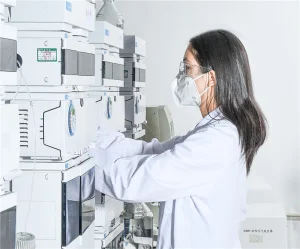
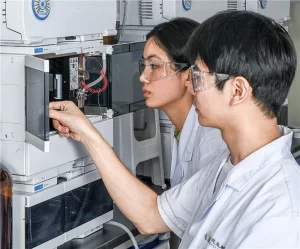
Global regulatory bodies require reproducible visual and digital chromatography. Modern Chinese HPTLC laboratories operate strictly within the framework of USP <203>, Ph. Eur. 2.8.25, and the Chinese Pharmacopoeia (ChP), replacing manual sample deposition with automated spray-on application.
Moving beyond simple retention factor (Rf) calculation, state-of-the-art Chinese contract analytical facilities interface planar chromatography directly with mass spectrometers (HPTLC-MS) to extract unknown analyte zones in seconds, resolving target identification without tedious isolation.
By pairing TLC plates directly with microbial suspensions, enzyme assays, or antioxidant solutions, our bioautography systems pinpoint bio-effective chemical species (e.g., radical scavengers or acetylcholinesterase inhibitors) before scale-up extraction begins.
Why Tier-1 pharmaceutical, nutraceutical, and personal care brands partner with Chinese specialized HPTLC service providers.
With high-value plant extracts like Ginseng, Ginkgo biloba, and Rhodiola facing intentional dilution or spike adulteration with single flavonoids, global procurement directors leverage comprehensive HPTLC fingerprinted profiles to verify exact botanical chemotypes instantly.
Whereas HPLC and LC-MS run serial injections taking 30–60 minutes per sample, planar chromatography runs up to 30 lanes simultaneously on a single 20×10 cm plate under identical mobile phase vapor conditions, slashing analytical solvent cost by up to 85%.
International audits demand 21 CFR Part 11 electronic records. Leading Chinese testing laboratories employ digital densitometers equipped with recalibrated spectral scanning (190–900 nm) to secure quantitative validation curves alongside Raw Image TIF metadata.
| Analytical Dimension | Traditional Open Column / TLC | Conventional HPLC / UHPLC | Automated Instrumental HPTLC (China 4.0) |
|---|---|---|---|
| Throughput (Samples / Run) | Low (Manual, 1–5 samples) | Serial (1 sample per injection) | High-Parallel (Up to 30 tracks concurrently) |
| Solvent Consumption | Unregulated, high waste | High (50–150 mL per multi-batch run) | Extremely Low (<20 mL for entire plate) |
| Matrix Tolerance (Crude Oils/Tar) | Variable, unreliable | Column fouling risk; heavy pre-cleaning | 100% Matrix Robust; stationary phase is disposable |
| Validation Regulatory Compliance | Subjective visualization | Fully Quantitative (USP, EP, ChP) | Fully Validated Under USP <203> & Ph. Eur. 2.8.25 |
Combining world-class botanical biodiversity with precision automated manufacturing and integrated analytical pipelines.
Hunan and central China serve as the nexus for indigenous herbal raw materials and modern pharmaceutical equipment clusters. With immediate proximity to major GAP plantation bases, raw herbals undergo HPTLC validation at harvest, preventing degradation during transport.
Our pilot plants and production complexes transfer benchtop R&D batches directly into automated extraction vessels (1,000L to 10,000L). Online real-time analytical assays safeguard concentration and spray drying, delivering reliable active profile preservation.
Operating under strict confidential entrustment contracts, formulation formulas, chromatographic signatures, and extraction parameters are ring-fenced within dedicated secure digital servers, guaranteeing client exclusivity across worldwide territories.
Real-world integration across regulated therapeutic development, nutritional supplements, and functional cosmetics.
Accelerating drug master file (DMF) creation and Investigational New Drug (IND) applications. Developing validated identification assays for multiple marker substances in complex polyherbal preparations.
Combating intentional raw ingredient substitution. HPTLC digital image profiles differentiate high-potency harvest extracts from exhausted marc, safeguarding clean-label compliance for global retail.
Verifying polyphenol, flavonoid, and triterpene stability within complex cosmetic matrices including oil-in-water emulsions, serum gels, and topical natural balms without column clogging.
Comprehensive technical and commercial answers tailored for QA Directors, Lead Scientists, and Global Supply Managers.
Classical Thin-Layer Chromatography relies on manual micropipette application, open development tanks, and manual observation, leading to high variable errors. Instrumental HPTLC utilizes optimized stationary phases (smaller, uniform 5–6 µm silica particle layers), computer-controlled automated spray-on band deposition, precision chamber relative humidity control, and calibrated photodocumentation under 254 nm, 366 nm, and white light.
Yes. Our analytical method development adheres strictly to ICH Q2(R1) guidelines, USP <203> (High-Performance Thin-Layer Chromatography Procedure for Identification of Articles of Botanical Origin), and European Pharmacopoeia chapter 2.8.25. All validation data packages include specificity, repeatability, stability on plate, and intermediate precision profiles recognized across international regulatory authorities.
Natural herbs naturally fluctuate in compound ratios due to climate, soil, and harvest season. HPTLC fingerprinting addresses this by establishing baseline chromatographic patterns using multiple reference samples alongside pure chemical standards, setting acceptable Rf variance (±0.02) and visual band density limits rather than relying exclusively on a single marker.
Through our integrated pilot and commercial industrial manufacturing bases, active botanical compounds are provided as spray-dried powders, concentrated extracts, soft pastes, and purified volatile oils. Finished consumer dosage solutions include softgels, hard-shell capsules, tablets, multi-dose oral liquids, and effervescent granules.
Select your specialized research service, analytical validation protocol, or contract pilot manufacturing module.